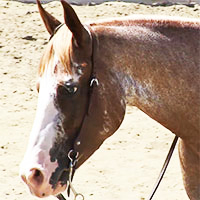
How To Choose The Right Bit For Your Performance Horse
By Larry Trocha
A pro trainer’s advice about the bitting process.
What bits to use and when to use them.
Dear Friend and Horseman,
Welcome to another Horse Training Tips Insider.
You know, one of the most frequent questions I get from my Horse Training Tips
subscribers is about bits and bitting. It seems there is a lot of confusion about when to use a certain type of bit and when not to.
In this newsletter, I want to try to clarify some of the misconceptions about bits and how to use different types of snaffle bits and curb bits to their best advantage.
Let’s start with snaffle bits.
Most colts should be started in a snaffle bit. And, many older horses that need re-training should also be schooled in a snaffle bit.
To my way of thinking, a horse should be ridden in the mildest bit that he will respond to for the job which he is intended to do.
Here is the reason why:
Most horses will lose some of their sensitivity as they get older.
A two year old colt will have a much more sensitive mouth than a ten year old horse. The more pressure or abrasiveness the horse’s mouth is subjected to, the quicker it will toughen and lose its sensitivity.
That is why I want to use as mild a bit on the horse as I can get away with. I want to preserve the sensitivity of the horse’s mouth as much as I can.
LET ME CLARIFY:
I did NOT say I’m going to use the mildest bit possible, no matter what.I said, I want to use the mildest bit possible that WILL GET THE JOB DONE.
If a horse absolutely refuses to respond to a very mild bit, then I’ll step up to the next bit in the sequence.
Now, don’t confuse a mouth that is merely “sensitive” with a mouth that is “educated”.
A horse’s mouth can be very sensitive but if its not also educated on how to respond to pressure, the sensitivity really doesn’t do you much good.
Ideally, you want both… an educated mouth that responds and is sensitive to light pressure.
With that idea in mind, a green colt will usually be ridden with an o-ring snaffle that has a smooth 7/16” mouthpiece. And you stay with that mild bit until the colt doesn’t respond to it well enough anymore.
Here is where a lot of folks get confused.
They don’t know what bit to go to next. Should they go to a snaffle bit with more “bite” to it or should they go to a curb bit?
Generally, the horse should stay in some form of o-ring snaffle bit until he is well along in his training. Ideally, the horse should be taught to do everything that you want him to while being ridden in the snaffle bit.
So, if you want your horse to be a reining horse, you should teach him to stop, spin, change leads etc. in the snaffle bit.
Once he knows how to work, then you can step him up to a curb bit. Curb bits are for “refining” the training that you have accomplished with the snaffle.
Same goes for a cutting horse. He should be in a snaffle bit while he learns to stop, turn and rate the cow.
I believe the snaffle bit is the best tool for teaching a horse how to position himself and use his body correctly.
Any performance horse needs to learn to give his head to the direct rein, move his shoulders off the indirect rein and position his ribcage and hindquarters from leg pressure.
Here is the sequence of the various types of snaffle bits that I use. Be aware, I no longer sell these bits on my website as my suppler has retired. I left the photos up so you can see the type of bits I’m talking about.
I try to do most of the foundation training with an o-ring snaffle with a 7/16” diameter mouthpiece. I stay with this until the horse is too heavy in it and I can’t get him to respond as lightly as he should.
To get the horse to lighten up and respond, I’ll try schooling him with a snaffle that has a mouthpiece that is smaller in diameter… usually a 3/8” mouthpiece.
With some really sensitive horses this is all the snaffle I’ll need. But for the majority of horses it won’t be quite enough.
Most horses are going to need a snaffle with a thinner mouthpiece so I’ll go to my absolute favorite snaffle…
My favorite training snaffle has a thin, smooth mouthpiece that is 3/16” in diameter. I call it a “thin, smooth-wire snaffle”.
I love this bit because it gets the desired results but isn’t harsh or abrasive to the horse’s mouth.
I’ll use this bit to lighten a colt up for a few days and then I’ll switch back to the regular snaffle. After a while though, this is the bit I’ll be using to do MOST of the training.
I’ll stay with the smooth-wire snaffle just as long as I can. The horse will be taught the majority of what he needs to know wearing this bit.
However, sometime during the training process, a horse will need to be lightened up even more. Especially the older horses that are being tuned up or re-trained.
So to get the job done, I’ll go to a twisted-wire snaffle. Either the regular or the thin twisted-wire.
These twisted-wire bits have some “bite” to them and will convince even an older, hard mouthed horse to respond and lighten up.
Even though it works well, be aware that a “twisted” mouthpiece is abrasive and can sore a horse’s mouth if it’s used too many days in a row or too harshly.
I recommend riding the horse with it for one or two days to lighten him up and then switch back to the smooth-wire snaffle.
Side note:
One of the questions I constantly get asked is why I don’t use a “running martingale” with my snaffle bit to help position the horse’s head.
The answer is simple…
In my opinion, the running martingale DOES NOT work well.
If you adjust it short enough to encourage the horse to flex at the poll for vertical flexion, it is too short and interferes with lateral flexion.
If you adjust it long enough not to inhibit lateral flexion, it is too long to help with vertical flexion.
For 10 years, I trained with a running martingale purely out of habit. I finally asked myself… why am I wasting time and money on a piece of equipment that doesn’t work? That was 15 years ago and I haven’t ridden with one since.
If you want to try a piece of equipment that DOES HELP a horse learn to give to your hands, supple-up and flex at the poll… use a German martingale.
It’s the best horse training aid there is.
Okay, now let’s get back to the bitting process.
Again, as soon as the horse lightens up and is responding well, I’ll
switch back to a milder bit.
The practice of using a stronger bit to lighten a horse up and then switching back to a milder bit for every day riding, works really well to preserve the horse’s mouth while keeping him working right.
Read the above paragraph again… its key.
Be aware, there are always exceptions to the rule.
Some horses just won’t lighten up the way they should in a snaffle bit. For those horses, you are going to have to go to the “next stage” of the bitting process sooner than you would the average horse.
After the horse has a good idea of what is expected of him and is pretty far along, I’ll start riding the horse in a “transition bit”.
Transition bits are middle-of-the-road bits used to transition the horse from the snaffle to a regular curb bit. Transition bits are the stepping stones between the green horse and the finished horse.
When I feel the horse is ready to leave the o-ring snaffle, I’ll move up to a mild transition bit.
The next bit in the sequence is my favorite transition bit.
It’s a loose shank bit (Bob Loomis shanks) with what is called a “Billy Allen” mouthpiece. (Billy Allen was a top trainer who invented this mouthpiece many years ago. The design has stood the test of time as one of the best bits ever invented).
What I like about this bit is that it gives the horse the “feel” of being ridden with a curb without scaring the horse.
The reason why is because the Billy Allen mouthpiece moves and is flexible similar to a snaffle.
The difference is, the Billy Allen mouthpiece has a “roller” that is molded over the middle joint. This roller “limits” the movement of the mouthpiece.
The horse gets the feel of a mouthpiece that is almost “solid” like a regular curb bit yet still has some “flex” to it.
This semi-solid mouthpiece gives you a lot of control without scaring or worrying the horse. Most horses love this bit and you can usually leave a horse in it for most of his training.
Most horses, I’ll ride with the 8” shanks.
This is also the primary bit I use to teach a horse to neck rein.
The loose shanks and flexibility of the mouthpiece allows me to use a direct rein to position the horse’s head before I apply the neck rein. It’s very easy and very effective. (You can see how I do this in my “Teach Your Horse to Neck Rein” video).
You can teach a horse a lot in the Billy Allen. And some horses work so well in it that you can keep them in it for years. However, most horses will eventually need to be moved up into a regular, solid-mouthpiece, curb bit.
For those horses, the next bit I’ll use will be a low-port mouthpiece with 8” loose shanks (cheeks).
I like using the low port as the horse’s first solid mouthpiece becauseis relatively mild. The bit pressure is more evenly distributed over the tongue and bars of the horse’s mouth.
Important note:
Even though I’m advancing the horse in the bitting process, I still want the curb bit to have “loose” shanks. The loose shanks make it much easier to take a horse’s head to the side and get lateral flexion.
After the horse gets farther along in his training, then “solid” shanks can be used with good results.
I’ll ride a horse for a while with this low-port curb bit and see how he responds with it.
From this point on, it’s just a matter of experimenting with different bits to see what the horse responds to best.
Some horse’s can stay in the low port for years and years. Others will need to be moved up to a medium or high port bit. With the higher port, there is less tongue pressure and more bar pressure. The majority of horses will respond well to this.
Keep in mind, all through the training and bitting process, if I run into a problem, I’ll sometimes go back to an o-ring snaffle to iron out the trouble and regain the horse’s confidence.
Usually, a few rides in the snaffle fixes the horse up and I can go back to the curb bit.
Also, be aware that some horses just can’t stand prosperity. Ride these horses with a mild bit and they just take advantage of you.
I have a horse like this in training right now. Every time I go back to a milder bit to reward the horse for good performance, he cheats me and won’t work right. So I’m forced to ride him in a stronger bit most of the time.
Now, this particular horse behaving this way disappoints me but I don’t hold it against the horse. I don’t get angry with him for it. It’s just part of horse nature to take the easy way out and slack off.
In reality, most horses will slack off from time to time and not work up to their potential. They will test you by being heavy. Either they refuse to lighten up at all or they will get light for a while and then revert back to being heavy.
And you sure as heck don’t want them to slack off just when you are about to take them to a SHOW.
A day BEFORE the show or maybe even DURING the show, you want to ride the horse with your TUNING BIT.
A tuning bit is any bit the horse will respect and REALLY listen to.
It’s usually a stronger bit than the horse really needs on a day to day basis. But NOT so strong that it scares the horse.
Yes, I want the horse to have a lot of respect for that tuning bit but I don’t want him so afraid of it that it worries him.
Remember, a horse that is scared or worried will not work to his full potential. He’ll be tentative and prone to make mistakes due to his nervousness. You want him attentive and responding well but not afraid.
There are two primary “tuning bits” that I use.
One is for horses that are still in the o-ring snaffle. The other, I use on horses that are in a transition bit or a regular curb bit.
For the horses that are normally being ridden in an o-ring snaffle, I’ll use a curb bit that has a “correction” mouthpiece and very short, curved-back, “Argentine” shanks (loose shanks).
The correction mouthpiece will really get the horse responding well… especially for the stop.
This type of curb bit can easily be used on a snaffle bit horse because the shanks are so short and curved back that there is almostno curb action. The lack of leverage allows you to take the horse’s head laterally without scaring him.
On my horse’s that are normally ridden in a transition bit or curb bit, I’ll use a tuning bit that has a “correction” mouthpiece and seven (7″) inch, loose shanks.
This bit has some leverage to it but it’s still easy to get lateral flexion because the shanks are loose.
I should also mention, on some of the heavier horses, I’ll use a curb chain with this bit that has more bite to it than the usual one that I use. Usually, a dog-chain curb works well.
I’ll normally ride the horse with a tuning bit for a ride or two (or show in it) and then go back to whatever bit I normally ride him in.
I hope this information helps you with your horse training. If you would like to see what the different types of bits look like, click on the links below.
Check out the snaffle bits.
Check out the transition bits and curb bits.
Okay, that’s all for now. Good luck.

About horse trainer, Larry Trocha
Reining and cutting horse trainer, Larry Trocha
Training horses professionally since 1980, Larry Trocha lives in northern California where he trains and shows horses for the public.
Larry also offers instruction and clinics to riders who want to learn reining, cutting, reined cow horse and ranch versatility.
Larry is a long-standing member of the National Cutting Horse Association (membership #518) and the American Quarter Horse Association (membership #1187036).
You can contact Larry via his website: HorseTrainingVideos.com
Larry Trocha Training Stable
Phone: 209-642-2804
larrytrochahorsetraining@gmail.com

Go Back
