Greg Darnall Bits – Snaffles
Special Snaffle Bits for a Lighter, More Responsive Horse
Nothing feels better than a horse that is light and responsive. Here are some specially designed snaffles that will help your horse develop that light mouth.
These are the designs used and endorsed by almost every top performance horse trainer. They are second to none.
The bits are arranged on this page with the mildest snaffles listed first. Read Larry Trocha's Horse Training Tips newsletter which details how and when to use the different types of snaffle bits.
Specially designed snaffles that produce good results
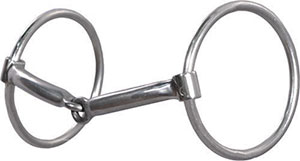
Standard Sweet-Iron
This is the colt starting bit of choice. The 7/16" sweet-iron mouthpiece is inlaid with strips of copper to produce a taste that horses like. The O-ring and flange at the end of the bars is a NO-PINCH design.
For horses that are a little too heavy in the 7/16" mouthpiece, I suggest
the smaller diameter 3/8" mouthpiece.
For best results, use occasionally with our German martingale.
7/16" Mouthpiece $49.00 
3/8" Mouthpiece $49.00 
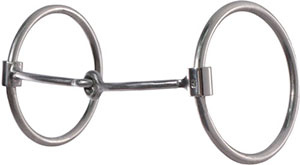
Thin Smooth-Wire, O-Ring Snaffle Highly Recommended

This is my favorite schooling bit. Great to use when your horse is too heavy in a standard snaffle. The thin, smooth-wire mouthpiece offers increased “sensitivity” without being abrasive. Used primarily for teaching better stops, collection and flexion. For best results, use occasionally with our German martingale.
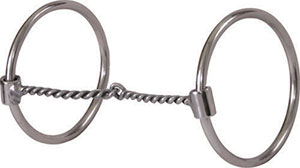
Standard Twisted-Wire, O-Ring Snaffle

One or two rides with this bit is usually enough to lighten most horses up. As soon as the horse starts responding the way you want, go back to your regular snaffle.
Thin Twisted-Wire, O-Ring Snaffle

This is what to use when you’re riding a heavy-mouthed horse that refuses to lighten up. It'll get good results with just about any dull mouthed horse. The 1/8” diameter mouthpiece has enough “bite” to get the job done. The horse should be ridden with this bit for several days or until he gets light. Then, you should go back to a regular or thin smooth-wire snaffle.
For best results, use with our German martingale.
Note: Be sure you are using the right type of reins & headstalls with these snaffles.
![]()
![]()
![]()
![]()
Phone Orders Call Toll-Free 1-800-811-4883 8AM to 8PM PST
Hello Larry,
I would like to thank you for all the information you are offering. It has opened my eyes to a large amount of problems I am causing with my 10 yr old mare. My horse was well trained before I acquired her as far as suppleness. She will flex and sidepass and give at the poll responsively at a standstill and walk. My issue is as soon as I ask for a trot or canter her head comes up and she is virtually impossible to rate/slow. At the moment I counterbend her in circles until she begins to listen to my requests which can take several minutes. If I allow her to circle without asking for a counterbend she will increase her speed until she is at a gallop. I ride her in a full cheeked eggbutt snaffle. Which bit would you recommend as the next step? I know that my riding is the main issue so if you could also recommend a dvd that might help I would be grateful. Thank you again. I am australian so please excuse any unusual terminology. Cheers, Kel.
Hello, I have a 10 year old quarter horse that needs some fine tuning. Someone worked with her in a Noavel and I am not sure that is what she needed. She rides great, neck reined but you have to hold far down on the reins. You have to be very alert with her because you don't know what she might do. She has rared back and bucked some. Any suggestions? Thank you!!
Hi, I have a 3 year old paint gelding that has been rode about 3 weeks and think he is a good reining prospect. He is not registered so I do not know what his blood lines are like. I want to know when a good time to start training would be?
What is the difference between a D-ring snaffle and an O-ring snaffle? Benefits, uses? And how do these bits prevent pinches? Do you believe all horses can be riden in a 5"?
Thanks!
I bought an 11 yr old paint gelding about two months ago. His former owner suggested a mullen sweet iron bit. I feel like I have no "whoa". Any suggestions?
I ride my older gelding in an o ring snaffle, but at times, he needs more 'whoa', especially when out of the arena, in higher stress situations. Should we go with a loose shank, low port bit? He has also been ridden in curb bits (previous owner used the Tom Thumb which just brings his head up to avoid the bit) Any advice?
Hi Larry
I have a 5 yr old piant mare that nas been broke to the for about 3 yrs and had been riden a good bit before I got her 4 months ago then I that had not reallly been taught any thing she come along way in a short time. she is very soft and light on the left but stiff and ridged on the right and about the only she bends at the poll is backing up.
will the german martingale help with these issues
Regards
Mr. Trocha.
I have a horse working on a copper loose ring snaffle, but as soon as I make contact with her mouth, she starts chewing on the bit. She still listens, but I would like to be able to half halt her and get her to round without getting her nervous. Is this a bit issue or another issue entirely?
Hi Larry. Question please…. I have your thin smooth wire snaffle that I have been using on my 7 year old occasionally with a german martigale; My 2.5yo filly has just started under saddle but is very heavy on the bit. Can I start using this snaffle on my starter as I have it set up with the G/M. Due to the wet season here she has only had about 5 rides since broken to saddle. Thanks and appreciated.
Andi.
Mr. Trocha,
I thoroughly enjoy all the information you present. Very sound advice with no BS! I have one question regarding the use of Tom Thumb snaffle bits. I have a 3 year old gelding that does not seem to like the 7/16 snaffle, but works well with the Tom Thumb except for spins and rollbacks. Your views, please and thank you very much.
Joe
Leave a Comment
16 Comments on Greg Darnall Bits – Snaffles