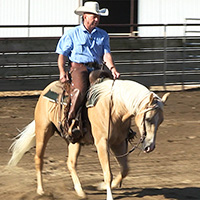
 How To Refine Your Horse’s Leads And Lead Departures
Dear Friend and Horseman,
Welcome to another “Horse Training Tips Insider”.
In a previous issue, I detailed how to teach a green-broke colt to take either lead. Even his “bad” lead that he really doesn’t want to take.
Once you get the horse willing and comfortable loping on either lead, it’s time to start refining his lead departures. In this issue, I talk about how to begin that refinement.
Some of my members emailed me with very good questions about leads, lead departures and lead changes. I thought it may be beneficial to share them with you, below.
Okay, let’s get started.
Lead change question:
Hi Larry,
I’m having problems with my leads and lead changes and was hoping you might give me some advice.
When I ask my horse to pick up the left lead, a lot of times he won’t. I move his hindquarters to the left and then kick him to lope but he’ll go into the wrong lead anyway.
Same thing when I ask him to do a flying lead change.
I’ll try to move his hindquarters over to get the change but he’ll usually not get the hind lead. He ends up in the correct lead in front and the wrong lead behind.
Is it me or the horse? What can I do?
Thanks for your help.
Jack
My reply:
Hi Jack,
Okay, lets get to your problem with the leads.
Keep in mind, without actually seeing you ride the horse, I can only guess what’s happening. However, your problem is a common one that I’ve seen many times so I’m pretty sure I know what’s going wrong.
I believe there are actually two separate things which are causing your problem.
Reason #1:
When you are moving the horse’s hindquarters over to cue for the lead, you are unknowingly letting the horse’s shoulders drift that direction too… causing the horse to pick up the wrong lead behind.
If you are going to ask your horse to pick up the left lead, you need to move his hindquarters to the left AND make sure his shoulders stay put.
It may even be helpful to move and hold the shoulders a little to the right.
Remember, ONLY the hindquarters should move in the direction of the lead. If you let the shoulders move in that direction too, it cancels out the hindquarters.
This recommendation applies to “FLYING LEAD CHANGES” as well as “LEAD DEPARTURES”.
Reason #2:
You are trying to use your legs for positioning the hindquarters as well as a cue to accelerate into the lope… and that won’t work (at least not on a green horse).
Whenever we use our legs to move a horse’s hindquarters over to pick up a certain lead, we are in fact “positioning” his body with our legs.
We need to keep our leg on the horse so his hindquarters STAY in position as he picks up the lope.
Once he is in the lope on the correct lead, we release our leg.
Because our legs are used for positioning in this maneuver, its necessary that we have an additional cue to ask the horse to accelerate into the lope.
If we try to use our legs for both positioning AND accelerating, it can confuse the horse and make him unsure of what we want.
So, once I have moved the horse’s hindquarters over, I cluck or kiss to him as his cue to pick up the lope. That way I can keep his hindquarters where I want them as I ask him to lope… There are no conflicting signals to confuse the horse.
Here’s what I suggest you do:
Practice your lead departures while riding at a walk, next to a fence.
Let’s say the fence is on your right and you want to pick up the left lead.
First, pick up your reins and move them slightly to the right.
Do this to block the horse’s shoulders from moving off the fence.
IMPORTANT: When picking up the left lead, move or hold the shoulders to the right… but additionally, his nose should be pointed straight ahead or bent a little to the left.
DO NOT PULL HIS NOSE AWAY FROM THE DIRECTION OF THE LEAD!
Second, move your right leg back a little, turn your toe out and apply enough pressure to move the horse’s hindquarters over to the left.
Push the hindquarters away from the fence about a foot or two. Keep them there as you continue to walk forward. Your horse will be two-tracking down the fence.
Third, with the horse’s hindquarters pushed to the left, cluck to the horse to ask him to lope.
If the horse lopes off on the correct lead, release all leg and rein pressure and let him go. The release of pressure let’s him know he responded correctly.
If he picks up the wrong lead, correct him by stopping immediately, move his hindquarters to the left, hold his shoulders to the right and ask for the lope again. Repeat as many times as necessary for him to take the correct lead.
NOTE:
Keep in mind, no “concentrated” training session should be longer than 15 minutes maximum. Any longer than that and you risk scaring your horse or make him dread being schooled. Then you end up with a “pin-eared”, “tail-wringer”.
Also, if you wear spurs… spur pressure should be applied with a “PRESSING” motion. Not a “JABBING” motion.
Here are some common mistakes when asking for “left” lead departures.
Mistake #1:
Letting the horse’s shoulders drift to the left and not keeping them right next to the fence.
Mistake #2:
Not keeping the horse’s hindquarters to the left as the horse breaks into the lope. Just as the horse starts to lope, the rider will mess up and release the hindquarters too soon. Thus, missing the lead.
Mistake #3:
The horse doesn’t pick up the lope when the rider clucks to him. You need to have your horse conditioned to accelerate when he hears the cluck. During your normal rides, cluck to the horse, if he doesn’t speed up, pop him on the butt.
Mistake #4:
The horse isn’t broke. To do lead departures or changes that are consistent and look good, the horse needs to have good initial training.
He needs to be supple. He needs to lightly move away from pressure and he needs to be good in the face and give to your hands.
If any of these ingredients are missing, performance will be inconsistent and way below par.
It may be hard for you to grasp a mental picture of all this just from reading this article. However, once you actually see it in action, it’ll make perfect sense to you.
To see it in action, I suggest you watch my DVD on flying lead changes or my online streaming video titled, “How To Lope Slow On A Loose Rein With Complete Control“.
Well, that wraps it up for this issue. I hope you liked it… and feel free to share it with your friends.
Until next time, have fun training your horse.
Larry Trocha
HorseTrainingVideos.com
