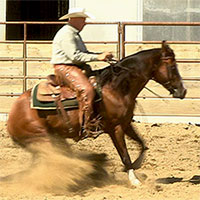
Horse Training Tips – Hindquarter Stop
Dear Friend and Horseman,
In my opinion nothing is more important to a horse's performance than a good smooth stop on the hindquarters. Without it, you just don't have a trained horse.
Unfortunately, this is also the maneuver that gives riders the most trouble. One of the "keys" to a hindquarter stop is the "timing" of the stopping cue.
In other words, you have to ask the the stop when the horse is in position where he "can" stop on his hindquarters.
If you ask for the stop at the wrong part of the horse's stride, you'll force him to do a jarring stop on his front end.
Be sure to listen to the audio instructions as well as the printed instructions below (scroll down).
The audio contains additional instructions that are not listed in print. Well worth listening to.
(If your computer has a slow internet connection, it may take a couple minutes for the audio to start. Click the arrow button to start the audio. Then, read the text below while the audio is loading)
Timing the Stride for a Stop on the Hindquarters

Here is the leg sequence of a horse going from a standstill into a lope and then coming to a stop on the hindquarters. The important thing to remember is that there is a lapse of time between when you give the horse a cue and when he recognizes the cue and responds to it.
In other words, when you say "whoa" it's going to take the horse a split second of reaction time to respond.
That's why you need to give the cue just "before" the horse's legs are in position to execute the hindquarter stop.
The ideal situation is to ask for the stop when the horse's hind feet are in the air and on their way forward.
Saying "whoa" at this part of the stride, allows the horse to shoot his hind legs way under his body for the stop on the hindquarters. Below I explain the parts of the stride in relation to stopping on the hindquarters.
C. Unfortunately, this is the part of the stride where most riders say whoa and expect the horse to stop. You can see that the hind feet are on the ground pushing the horse forward. If the rider asks for the stop at this part of the stride the horse is literally forced to do a jarring stop with his front legs.
D. This isn't too bad. If the rider said whoa here, at least the horse has one hind leg free to stop with. He would stop with the left hind and the right front. The horse wouldn't do a good stop but it wouldn't jar your eye-teeth out either.
E. Ideally, this is the part of the stride to say whoa. Both hind feet are in the air, free to shoot forward for a smooth, hindquarter stop. On some horses, you could set the bit and give the horse a quick squeeze with your legs to shoot the hind feet farther under the horse's body.
F. Here, all four feet are in mid-air. On some horses that listen real close and don't require much reaction time, this is where you should say whoa.
G. The horse's hind feet have landed, it's time to set the bit.
H. The hind legs are way under the horse's body, stopping hard. Slack the reins. Quickly reset the bit if the horse hasn't come to a complete stop. Then slack again. Reset and slack until the horse is completely stopped.
As you can see, it's critical to ask for the stop at "exactly" the right part of the horse's stride. If your timing is off, you'll cause the horse to jam his front feet in the ground.
In my video, Teach Your Horse to Stop Light & Collected (Volume 1.5), I show you how to time the horse's stride perfectly. It's really not that hard to do…
… If you know the secret.
If you want to put a really good stop on your horse, here are the videos that will show you how:
- Foundation Training for the Stop and Back Up
- Teach Your Horse to Stop Light & Collected Volume 1.5
- Teach Your Horse to Stop Light & Collected Volume 2
SIDE NOTE: The information outlined above is great way to get your horse stopping on his hindquarters. It'll work well for most riders and most horses.
However, it's NOT the ONLY way. I share multiple stopping methods in my DVDs and Inner Circle website.
Until next time, have fun training your horse. Post your comments or questions below.

Larry Trocha
www.HorseTrainingVideos.com
Mr Trocha.
Thank you for advise and information, I have great respect for you.
I cannot wait to get on and try your technique of stopping, on a hot mare I have, she tends to run away from the halt and I end up pulling her head right in and then have to turn her to stop. Lets see what happens. I'll let you know
Larry, Thank you so much for this!!!
Hi Larry, thanks for your insights, they are much appreciated. I need your opinion on this one. In team penning, cattle sorting, and feedlot work my biggest weakness is that I can't get my horse to consistently be aggresive when blocking a small hole that the calf is running for. I need my horse to run to that little spot usually straight toward a fence and block the calf from going there. I'll give my horse the cue to get there, he knows exactly what it is I'm asking, then he'll hesitate enough for us to lose the calf. It drives me nutty sometimes as to why he's not brave enough or agressive enough to get there. What am I doing wrong????
Thanks Geraldine
Hi Larry, I have read your tips on horse properly stopping with their hind quarters, instead of
their front legs.
That is so true, about the bad timing thing, eh.
My neices dad wants to start haulter breaking my 10 month stud colt this afternoon,
Could You give me some tips before I start after lunch!
I want to teach him the right things, and this weekend were still needing to brand him!
O.K THANKS,
hi Larry,
i was just wondering about whats the best way to start teaching a horse slide stops once she stops on her hind quarters?
Hi Larry,
Thank you so much for your response. I figured you would have additional questions involving my horse's bucking problem.
The saddle and pad I'm using on him does fit properly. And as depicted in one of your tapes I don't cinch him up very tight when I first saddle him. I do it in increments after moving him around.
For the sake of argument let's assume that he is cold-backed and is also being some sort of a brat along with that. I'm basing those thoughts on the facts that 1) The folks on the ranch where I purchased him told me to longe him if I had not ridden him in a few days, and 2) His behavior has gotten worse over the past year. If you could help me with each of these problems I would be most appreciative. I'm considering taking him to a trainer to try to help me with these issues if you think it would be worth the effort.
I don't know how to handle the cold-backed issue and at the age of 65 don't relish addressing the bucking issue while mounted on him.
Thanks again,
Steve
Hi Larry,
I've got a problem with my 3 yr, old gelding that I can't seem to get corrected. When saddled his personality seems to change. He will fight you when longeing and has a propensity for wanting to buck, When mounted he goes through the same crap for a few minutes. I can mount and he'll stand easy for me and walk on when urged to do so, but as soon as you try to break him into a lope he will start bucking until he gets it out of his system. He's put me on the ground twice in the past year when I wasn't ready for his antics, and at my age that's no bargain.
Since I've had the animal, a little over 1 yr., he's never been beaten or abused and I don't believe he was prior to my purchasing him. He's very gentle in nature with no bad habits other than wanting to buck under saddle. Without the saddle on his back he'll go right on and longe and cooperate with me. He's got the beginnings of a nice stop and knows how to respond to leg pressure. I've ridden him on several trail rides for 4-6 hours at a time over some tough terrain with other horses and he has performed well.
I know it's difficult to offer any advise without seeing the animal, but from what I've described to you could you suggest anything I might try?
Thanking you in advance,
Steve
I'm new at reining, so me and my horse are learning how to slide and spin. I've got a pretty good consistent 5 foot slide stop on my Arab but I would like to build up a longer slide and he doesn't paddle with his front end and he'll bump me when his front end hits the groune. I know everybody states he is not built for stopping but he's come along way and I think I can get him to do more if I was correct. When I'm not doing my job right, he doesn't do his. When I'm relaxed I think he takes a few steps with the front legs to stay in positioned. For me it is hard to tell since I'm on him. Unfortunately I have a small arena and getting enough speed is a problem. I'm also starting to have problems with him anticipating me. Everything I've read tells me that a horse naturally paddles with the front end but I would like to think there are some things we might be able to do that would encourage this. Any ideas?
Larry, a friend sent me your links; what a great step back in time for me. I'd been around this type of Western training in my 20's, it's roots are classic training. I own Noel Jackson's book 'Effective Horsemanship' which is dressage based training. Same principles; if you don't give the cues at the right time, the horse cannot physically do what you ask. I have polo horses and I teach riding, but have had a hard time convincing my husband and other people that these methods work for the horse and that they are important to do (the time and effort factor). So, seeing your steps have been a great validation. Your videos are well done, any time you can break information down into specific progressive steps it is good for horse and rider both!
LARRY, I LEARNED A GREAT DEAL FROM YOUR TIPS
Leave a Comment


49 Comments on Horse Training Tips – Hindquarter Stop
