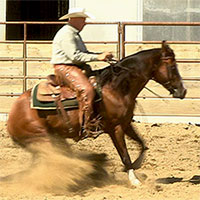
 How To Get Your Horse To Do A Balanced Stop On The Hindquarters.
A horse training cheat sheet.
Dear Friend and Horseman,
In my opinion nothing is more important to a horse’s performance than a good smooth stop on the hindquarters. Without it, you just don’t have a trained horse.
Unfortunately, this is also the maneuver that gives riders the most trouble. One of the “keys” to a hindquarter stop is the “timing” of the stopping cue.
In other words, you have to ask for the stop when the horse is in position where he “can” stop on his hindquarters.
If you ask for the stop at the wrong part of the horse’s stride, you’ll force him to do a jarring stop on his front end.
Be sure to listen to the audio instructions as well as the printed instructions below (scroll down).
The audio contains additional instructions that are not listed in print. Well worth listening to.
You need the Chrome or Safari browser to play this audio.
Click the arrow button to start the audio. Then, read the text below while the audio is loading.
Timing the Stride for a Stop on the Hindquarters

Here is the leg sequence of a horse going from a standstill into a lope and then coming to a stop on the hindquarters. The important thing to remember is that there is a lapse of time between when you give the horse a cue and when he recognizes the cue and responds to it.
In other words, when you say “whoa” it’s going to take the horse a split second of reaction time to respond.
That’s why you need to give the cue just “before” the horse’s legs are in position to execute the hindquarter stop.
The ideal situation is to ask for the stop when the horse’s hind feet are in the air and on their way forward.
Saying “whoa” at this part of the stride, allows the horse to shoot his hind legs way under his body for the stop on the hindquarters. Below I explain the parts of the stride in relation to stopping on the hindquarters.
C. Unfortunately, this is the part of the stride where most riders say whoa and expect the horse to stop. You can see that the hind feet are on the ground pushing the horse forward. If the rider asks for the stop at this part of the stride the
horse is literally forced to do a jarring stop with his front legs.
D. This isn’t too bad. If the rider said whoa here, at least the horse has one hind leg free to stop with. He would stop with the left hind and the right front. The horse wouldn’t do a good stop but it wouldn’t jar your eye-teeth out either.
E. Ideally, this is the part of the stride to say whoa. Both hind feet are in the air, free to shoot forward for a smooth, hindquarter stop. On some horses, you could set the bit and give the horse a quick squeeze with your legs to shoot the
hind feet farther under the horse’s body.
F. Here, all four feet are in mid-air. On some horses that listen real close and don’t require much reaction time, this is where you should say whoa.
G. The horse’s hind feet have landed, it’s time to set the bit.
H. The hind legs are way under the horse’s body, stopping hard. Slack the reins. Quickly reset the bit if the horse hasn’t come to a complete stop. Then slack again. Reset and slack until the horse is completely stopped.
As you can see, it’s critical to ask for the stop at “exactly” the right part of the horse’s stride. If your timing is off, you’ll cause the horse to jam his front feet in the ground.
New online video training course…
Horse Training Secrets For Big Stops!
The information outlined above is great way to get your horse stopping on his hindquarters. It’ll work well for most riders and most horses.
However, it’s NOT the ONLY way. I share multiple stopping methods in my “Performance Training Package“.
Until next time, have fun training your horse. Post your comments or questions below.

Larry Trocha
HorseTrainingVideos.com
Go Back
