Dear Friend and Horseman,
Welcome to another
Horse Training Tips Insider.
In my last newsletter,
I posted my answers to training questions sent to me by my subscribers
and online video members. The response to that newsletter was
overwhelming.
Many people wrote to me
saying how much they liked the information. So, in this issue, I’ve decided to do the same thing.
Okay, lets get on with
the training questions.
Answers to good horse training questions
Question:
Hi Larry
It`s me Pia. I have ordered some more of your training videos……cause
they are the best! – Anyway – I have a question for you – and I know
there may not be any real answers……..but
1. Any idea how to react – or what to do when a horse starts to buck
like hell? (excuse my language)
I got bucked off my
horse Tucker – he`s scared of everything – you never know when and
why he gets scared – and usually I just sit and relax…..but this day
he was really scared – and I didn`t relax.
I gave him some
spur – and then he jumped forward – and started a rodeo – I hung on for
some time – but then he made a sharp turn – and I flew off – landing in
a ditch – I was ok – but hurt for two weeks……so – if you have any
techniques to get you out of a situation like that……. I would
appreciate it. Thanks – and keep making those good videos!!!
Best regards
Pia
My answer:
Hi Pia,
Hey, thanks for getting my videos. I appreciate it.
First, let me say that
a certain amount of “spooking” is normal for a horse. It’s part of his
survival instinct. Evolution has produced a horse that managed to
survive by being wary. The horses that weren’t wary got eaten by
predators.
Because a horse has
this
inborn survival instinct, there are certain instances when “spooking” is
an absolutely appropriate behavior… quick,
sudden movements or something that looks like a hiding predator.
However, there are also times
when a horse is spooking at something when there is no good reason for
him to spook… an object that he has seen hundreds of times or an object
that is a long ways away.
There are also
horses that seem to spook at everything all the time. These usually have
problems with their vision or they have developed a “spooking phobia“.
The very first
horse I had when I was a kid had a spooking phobia.
His name was “Lucky” and he was one of the most dangerous horses I’ve
ever ridden. Actually, I was the one who was “lucky”. Lucky to survive
riding him!
My parents
bought Lucky for me as a surprise. I’d been bugging them to get me a
horse for years. He cost $75 and that included the saddle, bridle and
brushes. My parents were not horsemen. They had no idea how dangerous
Lucky really was.
Lucky was a
habitual spooker. When I first got him, he would spook almost
every ride. I can remember it like it was yesterday. We’d be riding
along and all of a sudden Lucky’s head would shoot up as high as it
would go.
He would be looking
at something waaaay off in the distance. He would then let out a loud
snort, wheel around 180 degrees, bog his head and buck 4 or 5 jumps,
then take off at a dead run.
I was bucked off in
the ditch beside the road so many times that I lost count.
Eventually, I
learned to weather the bucking storm. Lucky would wheel and go to
bucking and I could ride it but I still couldn’t stop him.
He’d be running
towards home full out. I mean really stampeding. When he realized I was
still on his back, he would try other tactics to get me off. His
favorite was to take me under the neighbor’s clothesline.
At a dead run, he’d
turn and go up the first drive way we’d come to. Then, zero in on the
clothesline and take me under it to knock me off.
It was
weird but Lucky was a genius at finding a clothesline to take me under.
He knew there
would always be one located beside a farm house. It was amazing
the way he would spot it and then head for the target like a guided
missile.
I learned
to step over and ride the side of the horse… the way I saw Indians do it
on TV. This kept me from getting “clothes-lined” right out of the
saddle.
Of course, when the
clothes-line tactic didn’t work, Lucky would then head for a tree or a
building and try to scrape me off on that. Again, stepping over and
riding in one stirrup kept me aboard. (My saddle sure got tore up,
though).
Lucky never did
completely get over his spooking habit. However, once he learned that he
couldn’t get me off, he didn’t do it nearly as often. If I had known
then what I know now, I could have fixed him.
Okay, this is what I do when a horse starts to spook at something
As soon as the horse sees the scary object, I start schooling him to get
him listening to me instead of concentrating on the scary object.
Keep him busy and moving.
Example: Let’s say you are riding in the pasture and your horse sees a
deer off in the distance and starts to spook. I’ll immediately start to
trot very small circles and ask the horse to give his head into the
circle. I might stop, rollback and trot the other way. I might spin,
back up or sidepass. Do anything that will take his mind off spooking.
The idea is to keep him
busy to get his mind on you instead of the scary object. As soon
as he’s listening to me and starting to get a little tired, I’ll let him
stand and rest while facing the scary object.
Usually, the horse
is more interested in catching his breath than spooking. This teaches
him to associate “resting” with “not spooking”. With
most horses this is
all you’ll have to do to address the problem.
However, in your email you said, “Tucker is scared of everything and you
never know when or why he gets scared”.
You need to know that
this isn’t normal behavior for a mature horse. Either his
eyesight is bad or he has developed a phobia about spooking.
Have is eyes checked
first. If they are okay you need to really address the spooking phobia.
I’ve had horses like
your Tucker. They would spook every five seconds and jump out from under
me or do some other dangerous action. I got hurt plenty of times.
Here is how I brought
those problem horses to their senses… I made the act of “spooking”
very, very uncomfortable for them. Let me repeat that in other words…
Whenever they spooked for no good reason, I made them wish they hadn’t.
I would spin them hard
and fast. I would jerk them to a stop. I would spank their butt and make
them really drive forward into small circles. I short, I made them
associate “spooking” with unpleasant, hard work.
In a short period of
time, they weren’t so keen on spooking any more. I guess they figured it just
wasn’t worth it.
You might keep this
information in
mind the next time Tucker decides to spook and unload you in the ditch.
Good luck,
Larry Trocha
Larry Trocha Training Stable
Pia’s reply:
Hi Larry
Thanks very much for your good reply….but Tucker could start balking
or bucking in a situation like that – it`s like he freezes up and won`t
move and then when you get him moving he`ll buck and pull stunts cause all
he wants is to get away – but I`ll definitely try it. Thanks again.
Pia
My answer:
Hi Pia,
I just can’t picture a trained horse doing that. However, if he
was my horse and he wouldn’t respond by going forward in a circle and
start to listen, I would take his reaction as a lack of respect
for my authority.
I’d make sure he
respected my requests or I’d make him wish he had.
When he tries to get
away or buck, use draw reins or an effective bit so you can get his head. And when he balks,
spank him on the butt with a crop to make him go forward.
Some horses really
resent being told what they can or can not do. Some of them will
fight and you can get hurt (of course, you already know this, don’t
you).
If Tucker is really serious about his bad behavior, it might be a good idea to get some help from a professional
trainer. If you lived closer, I’d advise you to send him to me. In 90 days, he’d be fixed.
Larry Trocha
Larry Trocha Training Stable
HorseTrainingVideos.com
My comments:
Okay, I know what
I advised Pia to do above sounded a bit harsh. And I’ll be the first to
admit, “on an average horse, it would be”. But, when a horse puts
his rider in physical danger again and again, any means to make
that horse safe to ride is more than justified.
Fixing the problem not
only makes him safer for his rider but it may save the horse’s life as
well. Dangerous or un-ridable
horses usually end up at the slaughter house. We can prevent that if we
can turn the horse into a safe and useful riding horse.
Now, I know for a fact
that a few people who read this newsletter are going to send me hate mail. They
will call me “bad names” because I advocate disciplining a
horse for bad behavior.
Well, so be it. If
those people don’t like what I say, they can unsubscribe from this
newsletter.
Furthermore, there are
people who will think that generous amounts of “petting and cookie
treats” will fix this kind of problem. They are mistaken.
If you sincerely want
to know why “petting and treats” won’t fix a spooking problem, I’m happy
to explain it…
If a horse
constantly spooks and
you pet him to reassure him, all you are really doing is rewarding
him for the spooking behavior. The “petting” will prolong the problem,
not solve it. Pet your horses for good behavior only.
After reading that, I
can just hear all the “cookie advocates” protesting… “petting is how I let
my horse know that everything is okay and that he doesn’t need to be
frightened”.
My answer is, “I agree
with you. With a normal
horse that occasionally gets
frightened, that is the appropriate thing to do. Ppet him to
re-assure him.
However, you need to
use good judgment.
There is a time when petting is the way to go and there is a time when
discipline is the appropriate action.
Want to see video examples of exactly how to accomplish this?
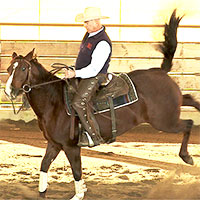
You can see a good example of this in my online training course titled, “Groom, Saddle, Ride & Fix Bad Behavior“.
In the course, you’ll learn how to deal with just about any problem you can imagine.
Including horses that rear, buck, balk, kick, bite, spook, are barn sour, buddy sour, won’t cross water and won’t go where you want.

Larry Trocha
www.HorseTrainingVideos.com
