
Dear Friend and Horseman,
Larry Trocha here.
Welcome to another Horse Training Tips Insider.
This particular issue is probably one of the most important ones I’ve ever written. Because the message here is so critical, I hope you read it a couple times over.
Okay, let’s get started.
Does your horse have any of these bad behavior problems?
- Bucking
- Rearing
- Kicking
- Biting
- Barn sour or refuses to leave other horses
- Pushes you around and won’t behave
- Bad manners and general lack of respect
- Balks and refuses to go forward
- Out of control or no control at all
If your horse has any of the problems listed above or is just difficult to train in general, then the following information may be just what you’re looking for.
You see, in many cases, what these behavior problems have in common is their ROOT CAUSE is the horse’s lack of RESPECT for the people who ride and handle them.
Gain the horse’s respect and the bad behavior usually goes away.
Keep in mind though, there are horses who are the EXCEPTION to the rule.
Those horses may have other issues which are triggering the bad behavior. Ingrained bad habits, pain, fear or psychological issues can definitely be a contributing factor.
So can a rider/handler who isn’t dealing with the horse’s situation the right way.
Some folks unknowingly PERPETUATE their horse’s bad behavior because they’ve never been taught an alternative way of doing things.
As a horse owner, this type of behavior can be hard to figure out. That’s because its kind of like a “catch 22” situation.
The horse misbehaves because he doesn’t respect you. And he doesn’t respect you because you can’t control him. And you can’t control him because he weighs 1000 pounds and is misbehaving.
It’s a vicious circle and a tough combination to deal with if you don’t know how to handle it.
Many people believe, if they just LOVE their horse more and provide everything he needs and give him treats to show him they love him… the horse will return that love by being well behaved.
Unfortunately, horses aren’t emotionally wired that way. It’s simply not in their nature.
Let me make this perfectly clear…
You won’t have any luck building a good relationship with a horse who doesn’t respect you.
Because this concept is so important, I’ve addressed it below. My goal is to try to give you a better understanding of “respect” issues and what to do about it.
Side note:
Many novice horse owners hope they can get their horse to stop the dangerous behavior by letting him have his own way… by feeding him “treats”… and hoping the horse will reciprocate the good intentions.
They quickly discover this doesn’t work… and in many cases, makes the problem worse.
In the beginning stages, many horse owners aren’t even aware that their horse is being disrespectful toward them. They have a hard time recognizing it. That’s because this behavior starts out very subtly and gradually gets worse over time.
This “respect” thing is a natural part of a horse’s instinct and is related to dominant or submissive behavior when relating to other animals.
In a herd of horses, every member has his place in the pecking order. The top horse is dominant over all the other horses. And, the horse at the bottom is submissive to all the other horses in the herd.
The dominant horses have the respect of the submissive horses and always get their own way. The submissive horses get no respect from the dominant horses and are always being pushed around.
The horses in the middle will be dominant to certain members and submissive to others. It’s the natural way of the horse. In all relationships, in all encounters with others, a horse will be either dominant or submissive.
How does a horse become dominant?
He becomes the dominate horse if he can CONTROL the other horse and MAKE HIM MOVE out of his way. If he can control the other horse, he in affect, becomes the submissive horse’s leader.
A dominant horse will be the one who kicks or bites any horse who crowds him or invades his space.
He will also exhibit his dominance by crowding, pushing or invading the space of other horses. He’s exerting his control.
Read the paragraphs above again. They are key.
Now, it’s not always the biggest or physically strongest horse who is dominant. Sometimes its a small horse. But it is always a horse that is willing to “impose his will” that wins dominance over the other horses.
When I was a kid, I had a little 14 hand tall palomino stallion. He ran with all the other horses out in the pasture. Even though he was the smallest horse of the bunch, he ruled over every single horse in the herd.
Why? How? Because he really wanted to and was willing to fight for it.
You see, he had the willingness to exert his will and let the other horses know what he would not tolerate.
He certainly wasn’t the strongest horse in the herd. But he was the one who, “in the blink of an eye”, would turn and kick any other horse that tried to push him around.
Now, the vast majority of horses prefer not to fight.
They are timid by nature. They may put on a good bluff but when their bluff is called, they back right down. So, any horse that exhibits even a little bit of aggressiveness is usually the winner.
Okay, so how does all of this relate to you and your horse’s behavior problems?
Well, like it or not, the horse sees his relationship with YOU the same way he sees it with another horse.
One of you is going to be dominant and the other is going to be submissive. Naturally, the horse would like to be the one who is dominant. He wants to be the one calling the shots.
Now, if the horse insists on getting his own way and you don’t correct him, you are in for trouble. He’ll get bolder and bolder and that’s when the behavior problems start.
Be aware, bad behavior doesn’t happen over night. It comes on little by little.
To have a good relationship with your horse, you have to be the dominant partner in the relationship. You have to make sure the horse sees you as his leader. This is what wins his respect, trust, and willingness to please you.
How do you go about this? Well, there are several different methods to get this done but in reality there is a definite “right way” and a definite “wrong way” to go about it.
One way is to just do what another horse would do out in the pasture — turn around and “whomp the bejeezus out of the horse whenever he does something wrong.
This will gain his respect… and it will get him to mind you.
However, there is more to it than that.
There are usually other ways of dealing with this type of problem. (Of course, with really bad or dangerous horses, a GOOD, HARD SPANKING is a lot better than doing nothing at all).
Usually, thoroughly teaching a horse to move out of your space will go a long way in gaining his respect.
Ground exercises of moving the individual parts of the horse’s body works great.
So does simply training the horse to RIDE better… teaching him to respond better to your hands and legs.
On the other side of that coin, trying to “pet” the horse into respecting you definitely won’t work. Feeding him cookie treats won’t do it either. You have probably already tried both and found they only make the horse worse.
Gaining your horse’s respect and trust requires the proper balance of training, discipline and rewarding the horse’s willingness to try for you.
Read the above line again.
Knowing how to do this is the key to transforming your problem horse into a dream horse. The kind of horse you have always wanted. It’s also the key to maintaining a good relationship with your horse. Keeping a good horse good.
I just can’t emphasize this “respect and trust” enough. Without it, you just don’t have a good horse. You’ll have hell training him. And you’ll have hell handling him.
The techniques used to gain a horse’s respect and trust are not complicated or difficult to learn. Just about anybody can do it if they know what to do.
To achieve good results, a horseman needs to know what training methods to use, HOW to apply those methods and WHY those methods are appropriate.
Below are a few questions that were sent in by my subscribers. If you pay close attention, you will notice a common theme.
You may notice that a couple of my answers are a little, shall we say, BLUNT. Well, what can I say. Sometimes I just have to say what needs to be said.
Question:
Larry,
I’m working a filly who was abused and is very dominant towards people. I have worked many ground hours with her and she has joined up, if I may say so, quite well.
She saddles fine and is very supple. I have been walking and trotting in arena doing circles. Today as I trotted around in a semi-small circle, she stopped and reared.
After she reared I asked for a trot again and exaggerated my posture forward. When I could feel her begin to stop and rear again, I would round my back more and lean further back.
How to correct and am I doing the right thing. I thank you.
D.A.
My answer:
Hi D.A.
I wouldn’t worry about your posture when the horse rears. I’d be more concerned with knowing WHY she reared in the first place. There is always a reason for bad behavior.
Knowing “why” is the key to permanently fixing the problem.
Usually, a horse rears as a result of balking or refusing to go forward. And is usually a sign of disrespect toward the rider or a lack of discipline.
In your email you said this mare is very dominant toward people… well, there you go. You need to change that. She needs to learn to respect people, not dominate them.
By the way, I don’t buy the “she was abused” theory. If that was true, she would be afraid of people, not pushing them around.
I also don’t believe that the mare “all of a sudden” just started rearing. This has been coming on for a while, you just haven’t recognized the warning signs.
Now, the other possible reason for a horse rearing is when the rider has a death-grip on the horse’s mouth, so make sure the reins are loose.
You can counter the rearing by going forward.
A horse can’t rear if he is moving ahead. When she begins to stop to rear, make sure the bit isn’t restricting her and then spank her butt to make her go. Don’t be timid with this, get her going.
Take care,
Larry Trocha
Larry Trocha Training Stable
HorseTrainingVideos.com
Question:
Larry,
I have never had so many problems with my horse since he got gelded.
Now every time I ride him he bucks for like 10 minutes and I thought that gelding was suppose to mellow a horse out and I am having lots of problems.
He doesn’t respect me anymore, and I really miss our bond.
He was awesome before and now it seems like he don’t trust me once the saddle is on his back. Its hell.
I haven’t fallen off yet but he’s going to over power me one of these days.
Now when I lead him he rears but I don’t want to send him to a trainer that’s going to beat on him. So what should I do?
Connie
My Answer:
Hi Connie,
Let me see if I’ve got this right.
You say your horse has no respect for you.
You say he is getting to be dangerous to handle.
You say you know it’s just a matter of time before he hurts you.
Then you say, in spite of him being extremely dangerous, you don’t want to discipline him. Hmmmmmm…
That makes absolutely NO sense!
You talk about how your horse doesn’t “TRUST” you any more. Well, since you don’t beat on him and only show him loving kindness… Why would he lose his trust in you?
Here’s the answer:
He never lost his trust in the first place. He only lost his RESPECT for you.
You haven’t learned enough about horse nature to know the difference.
Connie, here is my question to you.
What could you possibly do that would MOTIVATE your horse to behave?
My guess is, you already tried feeding him treats as a bribe… and found it doesn’t work.
Horses like this really don’t care if they hurt you.
This horse is having a great time pushing you around and using you for his personal entertainment. He’s having fun doing this, what motivation does he have to stop?
Connie, it’s time to get real here before you get seriously injured.
First of all, gelding him had nothing to do with the way he is acting.
This behavior has been building for a while (it’s probably the real reason why you had him gelded in the first place). But his behavior now is so bad you’re scared.
The bald face truth is that you need to make “bad behavior” uncomfortable for your horse or he’ll only get worse.
The consequence for not taking the appropriate action is a trip to the hospital emergency room or worse. Plenty of people have been killed from being struck by a rearing horse.
Larry Trocha
Larry Trocha Training Stable
HorseTrainingVideos.com
SIDE NOTE: According to the latest statistics, from the American Horse Council in Washington D.C., approximately 80,000 people each year are taken to the hospital emergency room because of horse related injuries? After reading this issue of the newsletter, are you at all surprised?
Question:
Hi Larry,
I have been receiving your emails and I was wondering if you could give me some advice.
I have a 6 year old gelding who was only broken in the summer of last year. Its a very slow process. My main problem with him is that he tries to bully me.
He rears and tries to scare me, when we are going forward he would stop and refuse to go on. he is making me very nervous. HELP
Susanne Stafford
My Answer:
Hi Susanne,
Your problem is a common one.
I’m impressed that you recognize what your horse is doing to you. Many riders seem to never have a clue.
Anyway, the root of your horse’s belligerent attitude is that he doesn’t respect you.
He’s testing your authority. He sees no reason why he should cooperate. After all, nothing unpleasant is happening to him for exhibiting his bad behavior.
You need to get him to understand that you expect him to be good. And he needs to understand there is an uncomfortable price to pay for bullying you around.
First, you need to make him behave and do exactly what you want on the ground. If he gives you any attitude or refuses to try, discipline him.
Once he has respect for your authority on the ground, it will be much easier to get him to do what you want when you are on his back.
Take care and good luck to you.
Larry Trocha
Larry Trocha Training Stable
HorseTrainingVideos.com
HorseTrainingTack.com
My Comments:
There are several more emails I’d like to address here.
One is from a 14 year old girl who’s mare kicks her on a regular basis (great kids horse, huh).
Another is from a guy who’s horse is gate sour and won’t leave the company of other horses either. When he tries to press the issue, his horse starts rearing, lunging and bucking.
A third question is from a lady who’s horse won’t respond to her leg cues and viciously kicks at her spur.
Her horse also runs backwards when she tries to get him to go forward. And when leading him, he pins his ears and gives her threatening looks like he’s going to bite her.
The truth is, the VAST MAJORITY of these bad behavior problems are simply a symptom of the horse’s lack of respect for his rider.
Gain the horse’s respect and the problem automatically goes away.
Keep in mind though, occasionally there are horses who are the EXCEPTION to the rule.
Those horses may have other issues which are triggering the bad behavior. Pain, fear or psychological issues can definitely be a contributing factor.
So can a rider/handler who isn’t dealing with the horse’s situation the right way.
Some folks unknowingly PERPETUATE their horse’s bad behavior because they’ve never been taught an alternative way of doing things.
Because these types of problems are so wide-spread, I decided to create a horse training video course that offers a solution.
Actually, the videos address TWO IMPORTANT ISSUES:
#1. Correct horsemanship practices.
#2. How to fix behavior problems, like bucking, rearing, biting, kicking and spooking.
Check it out below.
Want to know how to fix horses that buck, rear, bite, kick and spook? Want to know how to prevent the bad behavior from developing in the first place?
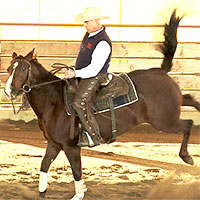
Groom, Saddle, Ride & Fix Bad Behavior
By reining and cutting horse trainer,
Larry Trocha
Well, this wraps it up for this newsletter. I hope you liked it.
Until next time, have fun training your horse.

Larry Trocha
HorseTrainingVideos.com
So at the bottom of this page, I have a “comments” is section. And just about every comment is asking for “Free Tips”.
If I felt “Free Tips” would help you, I would give them to you. However, I know that is not enough instruction to help you.
Get the training course. It’ll give you all you need to know to solve your problems.
