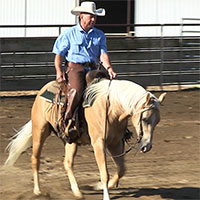
 How To Get A Green-Broke Colt To Take The Correct Lead
Dear Friend and Horseman,
Welcome to another issue of my “Horse Training Tips Insider”.
When you’re riding a colt that you’ve just started, you’ll notice that he almost always takes the same lead, no matter which direction he is loping. This is normal.
Just like people who are left or right handed, most colts will be left or right leaded. It’s not a big deal or something you should be overly concerned about.
All you really need to do, is get your horse to lope on his bad lead until he gets comfortable with it. Once he gets used to loping in either lead, then you can start adding “refinement” to his lead departures. (I’ll address “refinement” in an upcoming issue)
Of course, the problem is getting him to take the bad lead to begin with. With some colts, this can be fairly difficult. In this issue I describe how I get a colt to do that.
Before we get started, I want to emphasize the importance of having your colt supple enough to give his head to direct rein pressure. Meaning, if you pull the left rein, the horse will laterally bend and lightly give his head to the pull. This is IMPERATIVE!
OK, Let’s Get Started
Let’s say the colt won’t pick up the left lead. I trot the horse alongside the fence, placing the fence on my left. My horse will be parallel and about 6 to 8 feet from the fence.
From the walk or trot, I’ll turn the colt into the fence.
Halfway through that turn, I’ll use my outside leg (which would be my right leg) and I’ll cluck to him to pick up the lope. If he won’t pick up the lope, I might pop him on the butt with the end of the rein.
If I can get the colt to turn to the left and jump into the lope at the same time, he is almost forced to pick up the left lead.
Note: I should point out, if you have to pop the colt on the butt to get him to pick up the lope, make sure you pop him on the side “opposite” from the lead. In other words, if you want him to pick up the “left” lead, pop him on the “right” hip.
Also, its important to handle your reins correctly when doing this.
Let’s say you’re going to turn the colt into the fence to the left. Cross your reins over the horse’s neck and put them in your left hand. Have your left rein a few inches shorter than your right rein so you can turn him into the fence “nose first” with a direct (left) rein… and at the same time, the indirect (right) rein will apply pressure to bring the horse’s shoulders.
Have the end of your right rein in your right hand so that when you turn into the fence, halfway through the turn, you can pop him on the butt.
The timing of this is pretty critical. Halfway through the turn — while he’s facing the fence – use your outside (right) leg. Right after you PRESS him with your outside leg or spur, you pop him on the butt with the end of the rein using your right hand. If you want, you could use a bat to pop him on the hip, instead of the rein.
Sometimes you’ll have a horse that will pick up the correct lead – but then take a couple strides and switch to the wrong lead again. The way you fix that is to ride him into a circle “immediately” after he picks up the lead.
If he won’t hold the “left” lead, you’d turn him into the fence, jump him into the left lead, and then lope him into a circle to the “left”.
Be aware, the circle needs to be large enough to be comfortable for the colt.If you make it too small, you’ll actually cause him to drop the lead.
Also, if your horse is not supple (stiff as a board) and won’t lightly give his head laterally, this by itself will cause a horse to not take or hold the correct lead. They MUST give their head!
Leaning your upper body into the turn or circle, can cause the horse to take the wrong lead behind. Don’t lean, stay centered over your horse.
Here is the sequence of steps to pick up the left lead:
-
Ride parallel to a fence on your left
-
Turn to the left, into the fence
-
Halfway thought the turn, press or kick with your outside (right) leg
-
If necessary, pop on the outside (right) hip with the rein or bat
-
Go into the lope
-
Circle to the left to encourage him stay on the left lead
If you’ll be consistent with this procedure, it will have your colt picking up the correct lead almost every time. However, when you first start this, you have to make sure you don’t over do it. Repeating it two or three times each direction, is probably enough on a particular ride.
Don’t do it so many times in one ride that you scare him half to death. Do it just enough to give him the idea and that’s all. If he gets it, great. If he doesn’t get it, wait until the following day to try it again.
That way you’ll keep him calm and your progress will be smoother.
In my DVD, “Foundation Training For Turns, Circles and Leads”, I demonstrate exactly how to do this.
That’s all for now.
Until next time, have fun training your horse.

Larry Trocha
HorseTrainingVideos.com
