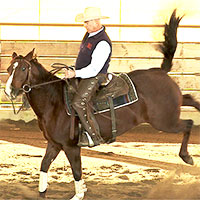
Horse Training Tips – Spooking

Dear Friend and Horseman,

Welcome to another Horse Training Tips Newsletter.

In my last newsletter, I posted my answers to training questions sent to me by my subscribers and Inner Circle members. The response to that newsletter was overwhelming.

Many people wrote to me saying how much they liked the information. So, in this issue of the newsletter, I've decided to do the same thing.

First though, I want to thank one of my subscribers for sending me such a nice "thank you" note. The note is unusual because it comes from a horsewoman who rides hunters and jumpers instead of cutters and reiners.

Here is what she wrote:

Hi Larry
This is probably a different type of "thank you" or endorsement.

I love your training videos!!!!

I am actually an English hunter/ jumper rider, and I have a 17h thoroughbred. He is very big and strong, and very much on his front end. I have tried to consider different methods of training and decided to give your videos a try- They worked great!

I love the fact that you show the training solutions on just average trained horses that actually make mistakes. You can see what to look for when things are going wrong. I also like the fact that you get into firm methods (when needed) and equipment, and show the proper way that they are used, and their results. Very PRACTICAL information.

Thank you!
Christina Lopez
Davis, CA

Well, you are very welcome, Christina. I love hearing stuff like that.

Okay, lets get on with the training questions.

Answers to good horse training questions

Question:

Hi Larry
It`s me Pia. I have ordered some more of your training videos……cause they are the best! – Anyway – I have a question for you – and I know there may not be any real answers……..but

1. Any idea how to react – or what to do when a horse starts to buck like hell? (excuse my language)

I got bucked off my horse Tucker  – he`s scared of everything – you never know when and why he gets scared – and usually I just sit and relax…..but this day he was really scared – and I didn`t relax.

 I gave him some spur – and then he jumped forward – and started a rodeo – I hung on for some time – but then he made a sharp turn – and I flew off – landing in a ditch – I was ok – but hurt for two weeks……so – if you have any techniques to get you out of a situation like that……. I would appreciate it. Thanks – and keep making those good videos!!!

Best regards
Pia

My answer:

Hi Pia,
Hey, thanks for getting my tapes. I appreciate it.

First, let me say that a certain amount of "spooking" is normal for a horse. It's part of his survival instinct. Evolution has produced a horse that managed to survive by being wary. The horses that weren't wary got eaten by predators.

Because a horse has this inborn survival instinct, there are certain instances when "spooking" is an absolutely appropriate behavior… quick, sudden movements or something that looks like a hiding predator.

However, there are also times when a horse is spooking at something when there is no good reason for him to spook… an object that he has seen hundreds of times or an object that is a long ways away.

There are also horses that seem to spook at everything all the time. These usually have problems with their vision or they have developed a "spooking phobia".

The very first horse I had when I was a kid had a spooking phobia. His name was "Lucky" and he was one of the most dangerous horses I've ever ridden. Actually, I was the one who was "lucky". Lucky to survive riding him!

My parents bought Lucky for me as a surprise. I'd been bugging them to get me a horse for years. He cost $75 and that included the saddle, bridle and brushes. My parents were not horsemen. They had no idea how dangerous Lucky really was.

Lucky was a habitual spooker. When I first got him, he would spook almost every ride. I can remember it like it was yesterday. We'd be riding along and all of a sudden Lucky's head would shoot up as high as it would go.

He would be looking at something waaaay off in the distance. He would then let out a loud snort, wheel around 180 degrees, bog his head and buck 4 or 5 jumps, then take off at a dead run.

I was bucked off in the ditch beside the road so many times that I lost count.

Eventually, I learned to weather the bucking storm. Lucky would wheel and go to bucking and I could ride it but I still couldn't stop him.

He'd be running towards home full out. I mean really stampeding. When he realized I was still on his back, he would try other tactics to get me off. His favorite was to take me under the neighbor's clothesline.

At a dead run, he'd turn and go up the first drive way we'd come to. Then, zero in on the clothesline and take me under it to knock me off.

It was weird but Lucky was a genius at finding a clothesline to take me under. He knew there would always be one located beside a farm house. It was amazing the way he would spot it and then head for the target like a guided missile.

I learned to step over and ride the side of the horse… the way I saw Indians do it on TV. This kept me from getting "clotheslined" right out of the saddle.

Of course, when the clothesline tactic didn't work, Lucky would then head for a tree or a building and try to scrape me off on that. Again, stepping over and riding in one stirrup kept me aboard. (My saddle sure got tore up, though).

Lucky never did completely get over his spooking habit. However, once he learned that he couldn't get me off, he didn't do it nearly as often. If I had known then what I know now, I could have fixed him.

By the way, in case you are wondering, Luck managed to put two people in the "doctor's office". A neighbor kid who was my best friend. And a girl from school, Kay Anderson who was my very first childhood sweatheart.

Okay, this is what I do when a horse starts to spook at something

As soon as the horse sees the scary object, I start schooling him to get him listening to me instead of concentrating on the scary object. Keep him busy and moving.

Example: Let’s say you are riding in the pasture and your horse sees a deer off in the distance and starts to spook. I’ll immediately start to trot very small circles and ask the horse to give his head into the circle. I might stop, rollback and trot the other way. I might spin, back up or sidepass. Do anything that will take his mind off spooking.

The idea is to keep him busy to get his mind on you instead of the scary object. As soon as he’s listening to me and starting to get a little tired, I’ll let him stand and rest while facing the scary object.

Usually, the horse is more interested in catching his breath than spooking. This teaches him to associate "resting" with "not spooking". With most horses this is all you'll have to do to address the problem.

However, in your email you said, "Tucker is scared of everything and you never know when or why he gets scared".

You need to know that this isn't normal behavior for a mature horse. Either his eyesight is bad or he has developed a phobia about spooks.

Have is eyes checked first. If they are okay you need to really address the spooking phobia.

I've had horses like your Tucker. They would spook every five seconds and jump out from under me or do some other dangerous action. I got hurt plenty of times.

Here is how I brought those problem horses to their senses… I made the act of "spooking" very, very uncomfortable for them. Let me repeat that in other words… Whenever they spooked for no good reason, I made them wish they hadn't.

I would spin them hard and fast. I would jerk them to a stop. I would spank their butt and make them really drive forward into small circles. I short, I made them associate "spooking" with unpleasant, hard work.

In a short period of time, they weren't so keen on spooking any more. I guess they figured it just wasn't worth it. (Actually, there was one exception. A psycho mare that eventually killed herself by running off a 15 foot cliff with her rider. Luckily the rider survived the fall with only minor injuries).

You might keep this information in mind the next time Tucker decides to spook and unload you in the ditch.

Good luck,

Larry Trocha
Larry Trocha Training Stable
www.HorseTrainingVideos.com

Pia's reply:

Hi Larry
Thanks very much for your good reply….but Tucker could start balking or bucking in a situation like that – it`s like he freezes up and won`t move and then when you get him moving he`ll buck and pull stunts cause all he wants is to get away – but I`ll definetely try it. Thanks again.

Pia

My answer:

Hi Pia,
I just can’t picture a trained horse doing that. However, if he was my horse and he wouldn’t respond by going forward in a circle and start to listen, I would take his reaction as a lack of respect for my authority.

I’d make sure he respected my requests or I’d make him wish he had.

When he tries to get away or buck, use draw reins so you can get his head. And when he balks, spank him on the butt with a crop to make him go forward.

Some horses really resent being told what they can or can not do. Some of them will fight and you can get hurt (of course, you already know this, don't you).

It might be a good idea to get some help from a professional trainer.

Larry Trocha
Larry Trocha Training Stable
www.HorseTrainingVideos.com

My comments:

Okay, I know what I advised Pia to do above sounded a bit harsh. And I'll be the first to admit, "on an average horse, it would be". But, when a horse puts his rider in physical danger again and again, any means to make that horse safe to ride is more than justified.

Fixing the problem not only makes him safer for his rider but it may save the horse's life as well. Dangerous or un-ridable horses usually end up at the slaughter house. We can prevent that if we can turn the horse into a safe and useful riding horse.

Now, I know for a fact that a few people who read this newsletter are going to send me hate mail. They will call me a "sadistic butcher" because I advocate disciplining a horse for bad behavior.

Well, so be it. If those people don't like what I say, they can unsubscribe from this newsletter.

Furthermore, there are people who will think that generous amounts of "petting and cookie treats" will fix this kind of problem. They are mistaken.

If you sincerely want to know why "petting and treats" won't fix a spooking problem, I'm happy to explain it…

If a horse constantly spooks and you pet him to reassure him, all you are really doing is rewarding him for the spooking behavior. The "petting" will prolong the problem, not solve it. Pet your horses for good behavior only.

After reading that, I can just hear all the "cookie advocates" protesting… "petting is how I let my horse know that everything is okay and that he doesn't need to be frightened".

My answer is, "I agree with you. With a normal horse that occasionally gets frightened, that is the appropriate thing to do. Pet him to re-assure him.

However, you need to use good judgment. There is a time when petting is the way to go and there is a time when discipline is the appropriate action.

Another good horse training question

Question:

Hi Larry,
I've been studying your rollback and spin tape, and sidepassing tape. I have a new horse I plan to train in reining so will be ordering more tapes from you in the future starting with your foundation series. But I have two questions as I'm watching your tapes..

Question 1: Do you establish a training schedule before you start training that extends over 3, 6 and or 12 months. For example.

Phase 1:
Rollbacks: Level 1 for first 30 days.
Level 2 for next 30 to 60 days (assuming Level 1 was achieved)

Spins:
Level 1 for first 30 days.
Goals: A. Achieve leg over maneuver in both directions slowly and smoothly
B. Head position is maintained consistently.

Level 2 for next 30 to 60 days.
Goals: A. Advance speed and ………

Stops:
Level 1 for first 30 days.
Goals: A. To achieve …………..
B. To achieve …………….

Question 2: Is it ok to practice different maneuvers together during the same practice session, and if so, which ones do you find work best together and which ones do you avoid.

By now I'm sure you've figured out I'm a novice. I'm trying to put together a training schedule to work on over this winter and plan to employ the information I get from your tapes. I found a 4 year old mare that has a good rein horse pedigree that has never been trained. So wish me luck and any tips you have would be much appreciated.

Thanks
Chuck

My answer:

Hi Chuck,
Thanks for getting my tapes. I appreciate it.
Yes, I can tell you are a novice but hey, every top horseman started as a novice.

I'm glad you are getting the Foundation Training Package because that is where you want to start with your new horse.

I have no regimented training schedule. Horses are individuals and there will be huge variations in their ability to learn. Some horses will learn to do a great spin in only a few weeks. Another horse may take 6 months of training before he has it.

I will usually work on several different things during a ride. I usually work on rollbacks and turnarounds while the horse is a little fresh and work on stops or lateral moves when the horse is tired and wants to stop and rest.

Your primary goal should be to get control of all your horse's moving parts.

Be sure you are able to move his shoulders, head, ribcage and hips. And I mean total control. The horse needs to let you position his body anytime without resistance.

If you can get this done, training for the maneuvers, like stops and spins, will be a piece of cake.

To see how an actual training session usually goes, you may want to get a few of my Inner Circle videos. These tapes show a very realistic type of training regimen.

Take care,

Larry Trocha
Larry Trocha Training Stable
www.HorseTrainingVideos.com

Well, this wraps it up for this newsletter. I hope you liked it.

Until next time, have fun training your horse.

Larry Trocha
Larry Trocha
www.HorseTrainingVideos.com

42 Comments on Horse Training Tips – Spooking Leave a Comment

May 16, 2011

Keri
12:01 pm #

Really like your comments for the spooking ladies horse. But, draw reins used without a professional can cause problems also. If he spooks and rears up and hits those draw reins that you have too tight he may just flip over. Great job!

May 16, 2011

LarryTrocha
12:46 pm #

@Keri: Very true.

Larry T.

May 7, 2011

Felicity
3:37 am #

Hello Larry,
just finished reading your training tips about spooking. I have been competing for years but I know that I will never know it all! I thought your advice on spooking was fantastic. It echos that old saying 'spare the rod and spoil the child'. I think too many people don't realize that a horse can be a very dangerous animal given the right or should I say wrong circumstances. I am nursing two broken ribs as I type this. I have a very seasoned horse that I have been showing for a number of years. He is a great horse but an occasional spooker and unfortunately the other day we parted company as he lost his footing. I remounted and continued without any further problems during the training session. Unfortunately I think age is catching me up. It's over 20 years since I had my last fall and obviously I just don't bounce enough anymore. Give me another week and I will be back in the saddle and working his butt off so he doesn't have time to spook at anything. I really look forward to receiving your newsletters, whether it is reenforcing what I do or providing me with a new approach. Thank you for sharing your invaluable experience and knowledge.
Regards from Oz,
Felicity

April 19, 2011

Ginny Nix
8:53 pm #

Larry, Theres nothing better in this world than a horse a person can trust not to buck or spook and are a joy to ride and do things with. There are many good ones out there. I wouldnt risk my life on a bad one. Period. Ginny

April 18, 2011

Paval
10:08 am #

Hi Larry
I'm in my fifties and have been riding most of my life. I believe regardless of how much one knows about a subject they can always learn something new and thus I do read your emails …. and thank you for that.
I would like to comment on your somewhat defensive justification in your follow up comment for the people that would think your correction made you a "saddistic butcher".
I have seen horses battle out in the field over hay, shelter or companionship and kick at eachother, while wearing horse shoes, that was far more severe than anything you suggested. The "cookie advocates" , that I do support, should always remember that there are times for cookies but there are also the occasional times when discipline is necessary. I'm in your corner in this regard.
Best Regards,
Pavla

March 1, 2011

Susan
2:56 am #

I have been getting your newsletters for a couple weeks now and they have been great. I have a 7 year old stud that I have been working with for about 3 months. He currently has some issues that have to be dealt with though. For starters he is barn sour but I have been working with him and he will finally work with me in the round pen but now we have to go back and learn everything over again outside the round pen… that is fine and your tips have helped a lot. But one thing I do need help with is when I go to get him out of the field he comes to the gate, which you would think I would like, right? He has no manners before I put a lead on him. He is all over me and I don't want to get stepped on. Now I love my horse but I am thoroughly attached to my toes…. Is there a way to get him to stay off of me but still come to me? Once I put a lead on him he has manners and we can work together and afterwords he is fine but not before. Any advice would be helpful because I really do not want him to step on me but would like him to come to me. Thank you

February 19, 2011

merle
9:23 am #

you are right about the pets and treats. i know a woman who did that and i told her you are going to get hurt one of these days your horses don't respect you. she said that she loved her horses and liked to give them treats and love on them. guess what she did get hurt and badly.

February 2, 2011

Ray
11:05 pm #

Great site. I have been getting your emails for a while now and learn a bit more with each one, thanks.

My question is related to your response to Ashraf where you state that 300 lb is just to much for a horse to handle. I don't own a horse yet but hope to after I retire. I am 6' 5" and weigh 230lb, I'm just big, don't have much I can loose. Is there a breed or a size I should be looking for considering my size?

February 3, 2011

LarryTrocha
12:35 am #

@Ray: Hi Ray. Just get a horse that is big enough to handle your weight. I'd suggest a horse of any breed that is at least 15.3 hands tall and 1200 pound and up.

There are plenty of horses that size out there. You just have to look.

Take care,

Larry T.

January 25, 2011

Ashraf Bibars
9:55 am #

I love this site, its very interesting and exciting, full of good information and people who love horses.

I'm a 46 year old novice who weight 300 lbs., any chance of me learning to ride? If yes ! what should i do differently because of my age and / or weight???

Thank You

January 25, 2011

LarryTrocha
2:30 pm #

@Ashraf Bibars: Hi Ashraf. Nothing wrong with your age. Plenty of people didn't start riding until their 60's.

Gotta get your weight down though. 300 pounds is just too much for a horse's back to handle.

Good luck. I know it won't be easy.

Larry T.

February 3, 2011

LarryTrocha
12:38 am #

@Ashraf Bibars: Hi Ashraf. I should also add… Your weight wouldn't be a factor if you found a nice BIG horse. I'd recommend one that is at least 16 hands tall and 1200 pounds and up.

Good luck.

Larry T.

January 18, 2011

Mike
6:16 am #

I have a 9 year old guilding that rides good but is always squealing like a stud. He just started this 2 years ago.

January 11, 2011

ann
7:40 am #

I am glad you tell it like it is Larry. And you probably keep a lot of people much safer for doing that. You are great. :)

Leave a Comment

Comments

Fields marked by an asterisk (*) are required.

Subscribe without commenting

Horse training videos, free horse training tips newsletter and online horse training video clips
HorseTrainingVideos.com
P.O. Box 986,
Penngrove, CA 94951
Customer Service: 707-782-1183
Phone Orders: 1-800-811-4883
Contact us
Larry Trocha Training Stable
(40 min. south of Sacramento)
24846 N Tully Road
Acampo, CA 95220
Larry Trocha: 209-642-3875
Training Stable
Wild West skin by Semiologic Reloaded Skins