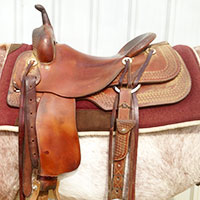
A well designed saddle for good balance
Choosing The Right Saddle
For Reining Or Cutting
By Larry Trocha
A pro’s advice about choosing a saddle that
will help you ride in balance and sit the stop.
(Applies to trail riders too).
Watch the VIDEO about how to
choose a good saddle.
Dear Friend and Horseman,
Welcome to another Horse Training Tips Insider.
Because of my training stable, I give lessons to non pros and amateurs who want to get started in reining, reined cow horse or cutting.
When it comes to riding, about 85% of those folks share the same problems. Most have trouble riding in balance and sitting the stop.
Many of the “balance” issues people have are actually caused by a poorly designed saddle that doesn’t allow the rider to flow with the horse. A saddle that doesn’t allow the rider to sit the stop. A saddle that causes a rider to fall forward during the maneuvers.
If you find yourself falling forward or loosing your balance when your horse is doing a stop, a spin or loping a circle, there is a good chance your saddle is hindering your balance rather than helping it.
In this issue, I’ve outlined the most important design elements of a saddle pertaining to a BALANCED ride.
I hope you find it useful.
I Want To Do Reining or Cutting. What Saddle Do You Recommend?
There are a lot of different brands of saddles available. Very few of them are designed well for riding or training a performance horse.
For cutting, reining and cow horse events, you definitely need a saddle that’s designed to help you “ride in balance and sit the stop.”
First, you want a saddle that was designed and built specifically for reining or cutting. Both of these designs have their individual advantages but remember, just because the manufacturer “calls” it a reining saddle doesn’t mean it was designed “well” for reining.
The reason for this is that most saddle makers are craftsmen, not horsemen. Very few of them know how to ride a performance horse. It’s kind of like trying to design a winning race car without ever having been in a race.
I often get asked if a “different” type of saddle is needed for trail riding. The answer to that is “no”. Riding in balance is riding in balance. If I were going on a trail ride, I’d still want the same, well designed, saddle.
Anyway, let’s get down to the nitty-gritty and talk about the different elements of a saddle and what to look for.
Seat: Remember, you want a saddle that will allow you to sit the stop. First of all the seat of the saddle should lay close to the horse’s back. The closer you can get to the horse the better. Anything more than a couple inches above the back is too high.
Also, the lowest part of the seat is called the “pocket”. If the pocket is too far back you’ll be forced against the cantle. Too far forward and you’ll slide up on the swells.
On my best saddles, the “pocket” is a little bit farther back than the middle of the seat. I’d say about 2/3rds of the way back from the front.
Beware of too small a seat. You need enough room to slide forward and back a little. The average size woman usually needs a 16” to 16 ½” seat. The average man, 16” to 17”. Also, I personally like a seat that is built up in front. This gives a more secure ride. However, the pocket should still be about 2/3rds of the way towards the back of the seat.
Horn and swells: This is the main difference between a reining saddle and a cutting saddle. In reining, your rein hand needs to be able to move unobstructed. Too high a horn or swells will get in the way. I’d want the horn no higher than 3 1/2”. And the swells no higher than 8”. I also like the horn to be small in diameter. In a cutting saddle, I like the swells and horn to be a little higher, around 8 1/2 or 9″. And the horn to be tilted a little forward. Actually, here on the west coast, a lot of folks will show their reiners and cow horses in a cutting saddle.
Stirrup Leathers: This is one of the most critical parts of the saddle, yet the most overlooked. You want the stirrup leathers hung far forward. Ideally, within a couple of inches right behind the swells. The closer to the swells, the better.
The reason is simple. To be able to stay balanced on a horse that stops and turns hard, you’ve got to sit down in the saddle. I mean way down, sitting on the cheeks of your butt (jean pockets). If the stirrup leathers are hung too far back, your feet will be behind your center of gravity, causing you to ride on your thighs and fall forward.
The result will be a loss of your balance which causes the horse to come out of the stop. Also the stirrup leathers and fenders should be made of fairly thin, flexible leather. For precise leg cues, you don’t want a lot of bulk between your leg and the horse. (you’ll never see a top professional riding a saddle with thick, heavy leather)
Cantle: Don’t buy one of those buckaroo saddles with a 6” high cantle. It’ll hit you in the back when you try to sit the stop. Quite a few of the “trail” saddles also have a steep, high cantle. Stay away from them. 3 1/2 inches high max.
Rigging: How your saddle is rigged is extremely important. And no compromise on rigging should ever be made when choosing a saddle. The saddle you want should have a Full-Double or a 7/8th rigging.
Some horses need a saddle with a 7/8 rigging (it’ll help keep the saddle from sliding back too far). But never, ever buy a saddle that is ¾ or center-fire rigged. The saddle will slide too far forward on the horse’s back.
Look at the way a horse is built. The narrowest part of his underline is right behind the front legs (girth). This is where the cinch automatically wants to go.
If a saddle with a 3/4 rigging is placed in the correct position on a horse’s back, the position of the cinch will be back towards the horse’s belly. It will just naturally migrate forward to the horse’s girth area, taking the saddle forward with it.
I also prefer the rigging Dee to be either in-skirt or dropped 3 or 4 inches below the swells (called a dropped rigging). This allows for the tree to pull down more evenly on the horse’s back. Both will be less bulky and give you closer contact with your horse, too.
Tree: Make sure the tree fits your horse’s back. If it’s too narrow or too wide your horse won’t be comfortable. Double check to be sure there is enough clearance between the horse’s withers and the gullet (a minimum of 1”).
A big problem with a lot of saddle trees, is that the bars don’t have enough curve or bevel at the end of the bars to fit the horse’s back. If your horse is a little sway-backed and the saddle tree is real straight, your horse may get a sore back.
The reverse is also true. If you put a tree that has a lot of curve on a straight-backed horse, he may get sore. The bars must match the shape of the horses back or there may be problems. Also, looking at the horse from the front, the angle of the bars should be close to the same angle of the horse’s shoulders.
When in doubt about a saddle, have a knowledgeable trainer take a look at how it fits your horse. His opinion might save you and your horse some grief.
Good luck.

Reining & cutting horse trainer,
Larry Trocha
About the author, Larry Trocha
Larry Trocha lives in Acampo, California where he trains horses for the public.
Larry also offers instruction to riders who want to learn reining, cutting or reined cow horse.
You can contact Larry via his website: www.HorseTrainingVideos.com